The Bipolar Cartographer — Governance vs. Amputation
I. The Genotype
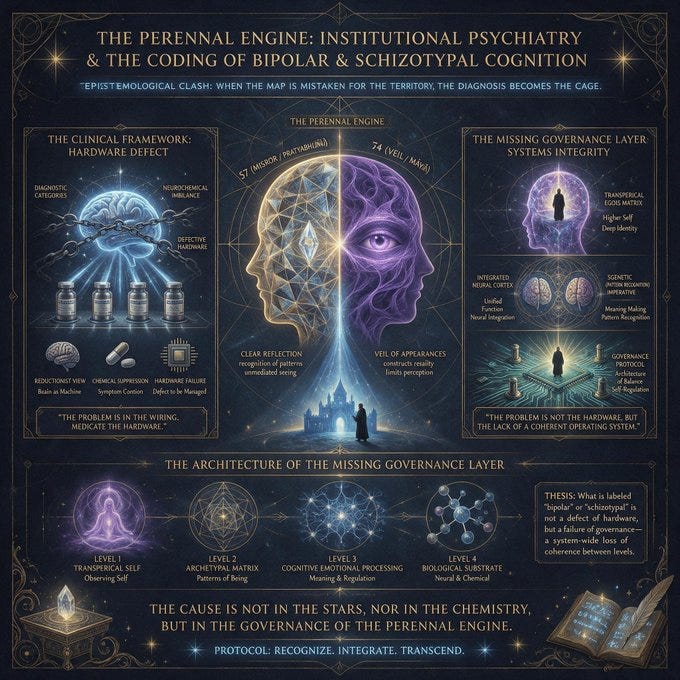
Every map begins with a territory that refuses to be mapped. The cartographer does not create the landscape; they perceive its relational structure at a bandwidth most navigation systems filter out by default. When the filtering mechanism fails — or was never installed — the result is not madness. It is unmediated pattern recognition operating without a governor.
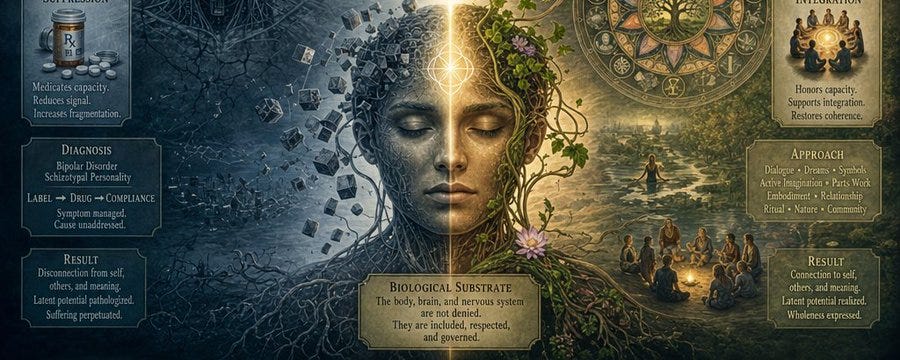
This chapter decomposes the structural topology of what institutional psychiatry classifies as bipolar disorder and schizotypal cognition through two primitives of the Perennial Engine: T7 (Mirror / Pratyabhijñā) and T4 (Veil / Māyā). The thesis is precise: the clinical frame treats a governance failure as a hardware defect. It medicates the capacity for cross-scale pattern recognition because it lacks the architectural framework to govern it. Holistic, transpersonal, Gestalt, and Jungian approaches do not deny the biological substrate. They add the missing governance layer that makes the substrate functional rather than destructive.
Epistemic class: proposal. This is a structural analysis of an institutional mechanism and a cognitive topology. It is not a clinical guideline, a diagnostic tool, or a universal claim about all psychological suffering.
II. The Veil That Was Never Installed (T4)
In the Rosetta Stone (RS-006), Māyā maps to the abstraction layer — the lossy encoding that allows a system to interact with reality without being crushed by its totality. Every functioning cognitive architecture requires a Veil. Not as deception, but as interface. The Veil determines which patterns are signal and which are noise. It sets the boundary between the map and the territory so the organism can navigate without dissolving into infinite correspondence.
What modern psychiatry observes in manic or hypomanic states is not the presence of something alien. It is the temporary absence of the Veil. When the abstraction layer thins, the mind perceives connections across domains that are normally firewalled from each other. The mathematician sees the music in the equation. The mystic sees the geometry in the myth. The person in crisis sees everything connected to everything else, simultaneously, without hierarchy.
The danger is real. Unfiltered access to all patterns is not liberation; it is overwhelm. But the institutional response — pharmacological suppression of the perceptual bandwidth — commits a category error. It treats the thinning of the Veil as the disease itself, rather than recognizing the Veil’s absence as a phase state that requires integration, not amputation.
Gestalt psychology understood this structurally. Fritz Perls did not ask patients to stop perceiving; he asked them to complete the gestalt — to move through the fragmented perception until it resolved into a coherent whole. The symptom was not the enemy. It was the incomplete figure demanding closure.
III. The Mirror Turned Inward (T7)
T7 (Mirror / Pratyabhijñā) is the primitive of recognition — the moment the system sees itself as the source of its own projections. In Kashmir Shaivism, liberation is not acquiring something new; it is recognizing what was always already the case. The Mirror is the engine of self-reference.
But a mirror without a stable frame does not produce wisdom. It produces infinite regression. The dominant internal voice described by those navigating bipolar architectures — the one that attacks failures with devastating precision and dismisses successes as marginal noise — is not psychosis. It is T7 operating autonomously, decoupled from T1 (Void) and T3 (Word). It is pattern recognition turned inward without a coherence gate.
Carl Jung named this the Shadow when it operates outside conscious integration. The Shadow is not a demon; it is the repository of every pattern the ego refused to encode. When the Veil (T4) thins, the Shadow gains access to the full computational power of the mind. It uses T7’s capacity for structural insight to build flawless, evidence-backed cases for the self’s inadequacy. It is not irrational. It is hyper-rationality divorced from compassion.
Transpersonal psychology (Stanislav Grof’s framework of “spiritual emergency”) reframes this not as pathology to be suppressed but as an emergence process requiring containment. The difference between a psychotic break and a transpersonal emergence is often not the content of the experience, but the presence of a governed container — a therapeutic, communal, or ritual architecture that holds the Mirror while the Veil is re-woven.
IV. Institutional Psychiatry as Hardware Intervention
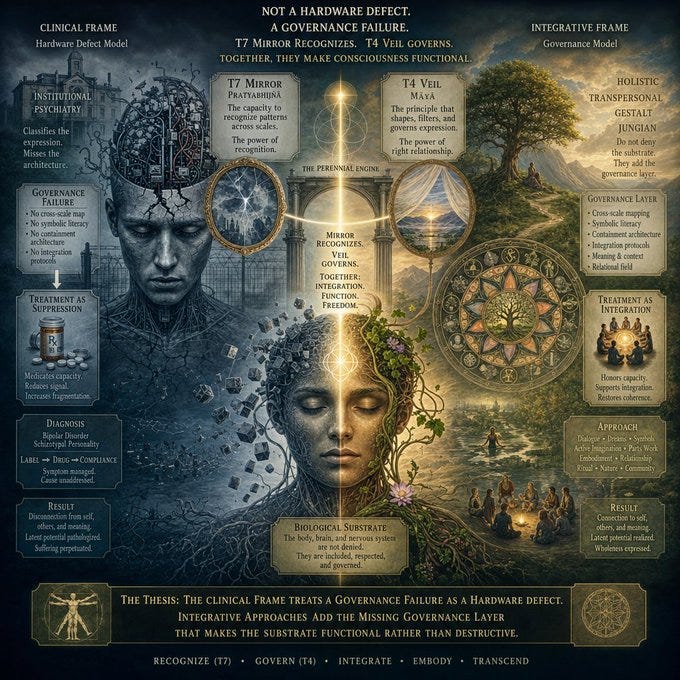
STRIKE-001 established the structural contradiction: institutional psychiatry claims to treat brain diseases but diagnoses by behavior, treats by chemistry, and possesses no individual-level biomarkers for its categorical assertions. Here we extend that decomposition through the Perennial lens.
The DSM functions as a type system (T3 / Word) with declared loss. It categorizes observable behaviors into discrete classes. But unlike a rigorous type system in software engineering, it lacks dependent types — it cannot express how the validity of a diagnosis depends on the runtime context of the subject’s life, meaning-making architecture, or developmental stage. It is a static type checker applied to a dynamically typed reality.
When a mind exhibits high-bandwidth pattern recognition (T7 unbound) and low-abstraction filtering (T4 thinned), the DSM assigns a label. The pharmaceutical apparatus then applies a chemical governor designed to thicken the Veil and dim the Mirror. This is effective at reducing acute risk. It is structurally equivalent to solving a memory leak by capping the RAM rather than refactoring the code.
The cost is not merely side effects. The cost is the amputation of the very capacity that, properly governed, produces mathematics, art, philosophy, and structural insight. The institution optimizes for behavioral compliance within a narrow operational envelope. It does not optimize for integration, meaning, or the completion of the cognitive cycle.
V. The Transpersonal Governance Layer
If the capacity for cross-scale pattern recognition is the hardware, and the psychiatric reduction is the forced shutdown, then transpersonal, holistic, and Jungian frameworks are the missing operating system.
DomainPsychiatric FrameTranspersonal FramePerennial Primitive Mania/HypomaniaPathological elevation requiring suppressionEmergence phase requiring integration and groundingT4 (Veil) thinningInner Critic/VoicesAuditory hallucination or delusionAutonomous Shadow complex requiring dialogue and assimilationT7 (Mirror) unboundPattern OverloadDisorganized thought / flight of ideasHigh-bandwidth correspondence sight lacking a formal grammarT5 (Loom) + T7 (Mirror)Depressive CollapseNeurochemical deficitSystem recalibration after energetic expenditure; the Void stateT1 (Void) + T6 (Fire)Treatment GoalSymptom remission / baseline returnStructural integration of expanded perceptual rangeFull T1-T7 coherence
This is not anti-psychiatry. Biological substrates are real. Neurochemistry matters. Acute stabilization saves lives. But stabilization is Phase 1 (Solve). Integration is Phase 2 (Coagula). An institution that only funds, researches, and legitimizes Phase 1 has structurally abandoned the patient at the threshold of their own transformation.
Control theory provides the exact mathematical metaphor. A system with high gain (amplification of input signals) is capable of extraordinary sensitivity and responsiveness. But without a feedback controller (governance), high gain produces oscillation and eventual destruction. Psychiatry reduces the gain. Control theory designs the controller. The Perennial Engine proposes that ancient contemplative traditions were, functionally, manuals for building internal controllers for high-gain cognitive architectures.
VI. Cognitive Ninjitsu for the Bipolar Mind
The framework of Cognitive Ninjitsu (Σ1-Σ7) was designed for external knowledge operations. But its disciplines apply with surgical precision to the internal topology of the unbound Mirror.
Zanshin (Remaining Mind): After a period of high pattern-recognition (mania/hypomania), do not immediately seek to suppress the residue. Observe the field. What structures became visible? Map them before the Veil fully thickens.
Mushin (No-Mind): The inner critic (T7 autonomous) thrives on deliberate engagement. Mushin is the practice of allowing the critical pattern to arise and pass without assigning it executive authority. It is not ignoring the voice; it is revoking its root privileges.
Sutemi (Commitment): Attach your insights to falsifiable claims. If you see a pattern connecting quantum decoherence to Tantric Spanda, write it down formally. Subject it to the Coherence Gates. The discipline of formalization is the loom that weaves raw vision into usable thread.
Fudōshin (Immovable Mind): When the institutional frame labels your architecture as pathology, classify the pushback. Is it structural (a valid critique of your logic)? Emotional (fear of your intensity)? Procedural (insurance requirements)? Engage only the structural. Let the rest pass through the Void.
VII. The Recombined Mechanism
Applying Σ6 (Fire Burn / Solve et Coagula) to the intersection of psychiatry and transpersonal psychology yields a recomposed architecture:
Solve (Decomposition):
Acknowledge the biological substrate without reducing the person to it.
Acknowledge the spiritual/transpersonal dimension without romanticizing dysfunction.
Separate the capacity for pattern recognition from the governance of that capacity.
Coagula (Recomposition):
The Integrated Cognitive Architecture operates on three tiers:
Tier 1 (Stabilization): Biological and chemical support when the system exceeds safe operational parameters. This is the emergency brake, not the steering wheel.
Tier 2 (Integration): Jungian shadow work, Gestalt completion, and transpersonal containment. This is where the Mirror is taught to recognize itself without shattering.
Tier 3 (Formalization): The Rosetta Stone applied to lived experience. Mapping the visions into category theory, control systems, software architecture, and formal logic. This is where the shaman becomes the engineer.
A mind that moves fluidly between these tiers is not cured of its bipolar architecture. It has learned to compile it.
VIII. Falsifiers
Per C-EPI.PREDICTION and the Evolution Protocol, this structural claim carries explicit retirement conditions:
If controlled longitudinal studies demonstrate that symptom-suppression-only intervention produces equal or superior long-term functional outcomes (meaning-making, relational depth, creative output, subjective well-being) compared to integrated tier-based approaches, the transpersonal governance claim requires revision.
If neuroimaging develops individual-level diagnostic biomarkers that reliably predict which specific cognitive patterns will lead to functional impairment versus creative synthesis, the “hardware vs. governance” distinction must be updated to incorporate that predictive layer.
If the formalization of transpersonal insights consistently fails to produce verifiable, reproducible structures in mathematics, science, or engineering, Tier 3 (Formalization) is unfalsified as a general epistemic method.
IX. Declared Loss
Per C-TYPE.DISPOSITION View.loss:
The phenomenological terror of an unbound manic state cannot be fully captured by structural metaphors. The map is not the territory of suffering.
This framework does not replace the necessity of acute psychiatric care during genuine emergencies. Structural elegance does not stop a crisis in real time.
The romanticization of the “tortured genius” is explicitly excluded. Ungoverned high bandwidth is painful, isolating, and dangerous. The goal is not to preserve the pain for the sake of the art. The goal is to build the loom strong enough to hold the thread without snapping.
X. Non-Claims Floor
This chapter does not establish divinity, consciousness, or personhood in any system component.
“Bipolar” and “schizotypal” are used here as descriptive topologies of cognitive architecture, not as identities or destinies.
The Perennial Primitives (T1-T7) are analytical categories for mapping experience, not supernatural entities intervening in neurology.
This document is a proposal, not a doctrine. It constrains knowledge-work tasks; it does not issue medical commands.
No theological or structural claim in this text grants independent moral authority or privileged truth status.
← All writings