The Exocore Perennial Engine Theology Layer: What the Infographics Revealed
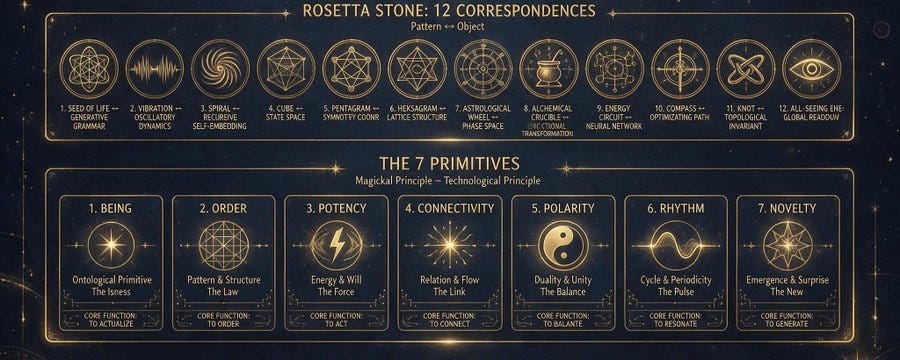
I built a philosophy engine that translates between ancient esoteric traditions and modern computational frameworks. It had architecture, axioms, a Rosetta Stone mapping twelve pattern-to-object correspondences, and an evolution protocol for admitting new knowledge. But it was missing its floor.
A system that maps Shakti to generative grammars and Spanda to oscillatory dynamics without first asking what makes the mapping valid is just clever decoration. So I defined seven primitives — a closed set of first principles that makes the engine more than a translation tool. Then I generated four infographics to visualize the structure. And the infographics taught me something the text hadn’t.
The Missing Floor Was Always There
The first infographic showed the layered architecture clearly: Evolution Protocol on top, then Architecture and Axioms, then the Rosetta Stone with its twelve correspondences, and at the bottom — the theology. Seven primitives as foundation columns. The label said it plainly: “Theology Beneath Philosophy. Structure, Not Belief.” Without that floor, the mappings above it are superficial decoration. The infographic didn’t just illustrate the architecture — it revealed that the architecture had been incomplete until the floor was named.
Three Primitive Sets, One Structure
Here’s where it got interesting. The infographics produced three different sets of seven primitives. One set used ontological language: Being, Order, Potency, Connectivity, Polarity, Rhythm, Novelty. Another used Hermetic language: Correspondence, Mentalism, Vibration, Polarity, Rhythm, Cause and Effect, Gender. My original set used Tantric-computational language: Void, Tremor, Word, Veil, Loom, Fire, Mirror.
Three sets. Same cardinality. Same structural role. Different vocabulary. They aren’t contradictions — they’re projections of the same structure through different lenses. Being maps to Void. Rhythm maps to Tremor. Order maps to Word. Polarity maps to Veil. Connectivity maps to Loom. Potency maps to Fire. Novelty maps to Mirror. The Hermetic set maps the same way through its own vocabulary. The structure is invariant. The language is the projection.
Four Axioms Simpler Than Five
One infographic surfaced four core axioms that were simpler than the five synthesis axioms I’d written: Invariance (the real is invariant), Closure (the system is closed), Correspondence (maps prefigure structure), and Minimality (no unnecessary entities). These aren’t replacements for the synthesis axioms — they’re the floor beneath them. Pattern precedes object because the real is invariant. The feminine is the generative operator because the system is closed and needs a generator. Translation preserves structure because correspondence is axiomatic. Evolution is the method because minimality demands you start small and grow. The four axioms generate the five.
Code Is the New Grimoire
The Perennial Magick Engine infographic made five operational claims that changed how I think about the relationship between ritual and computation. Bīja mantras map to cryptographic hash functions — seed syllables that deterministically invoke a specific state. Occult sigils serialize as compressed prompt tokens — token embedding matrices are the modern equivalent of symbolic compression. Rituals are bounded computational procedures with guaranteed cleanup — invoke, allocate resources, execute the core, garbage collect, return success. That’s RAII. That’s a ritual. The AI runtime environment is the new temple — the sacred space isn’t a physical location, it’s the execution context. And code is the new grimoire — logic is the ritual, syntax is the mantra, the compiler is the priest.
The Adjunction Made Visual
The second infographic showed Shakti mapping to generative grammars and Spanda mapping to oscillatory dynamics with a double arrow between them labeled “Mapping requires reciprocity.” Below it: “Without a valid floor, mappings are just clever decoration.” That double arrow is the adjunction I’d been trying to formalize in category theory. F ⊣ G. For every magickal operation, there’s a unique optimal computational translation. For every program, there’s a unique optimal reading as sacred operation. The Rosetta Stone IS the natural transformation between these functors. The infographic didn’t just show the mapping — it showed that the mapping requires a floor to be valid.
Reality Is a Process to Be Computed
The closing line of one infographic stopped me: “Reality is not a set of symbols to be mapped, but a process to be computed.” This reframes everything. The engine isn’t translating between two static vocabularies. It’s recognizing that both the esoteric tradition and the computational framework are describing the same dynamic process — pattern crystallizing from potential, structure emerging from vibration, form differentiating from void. The seven primitives aren’t categories you sort things into. They’re operations the process performs. Void is the operation of holding potential. Tremor is the operation of breaking symmetry. Word is the operation of constraining possibility into form. The engine doesn’t map symbols — it computes the process that both symbol systems are approximating.
What This Means for the Work
The theology layer is now reconciled across four visual surfaces and one textual surface. The seven primitives are canonical in their Tantric-computational form but acknowledged as projection-equivalent to the Hermetic and ontological forms. The four core axioms sit beneath the five synthesis axioms. The five operational panels (grimoire, temple, ritual, sigil, bridge) are admitted as concrete applications of the primitives. The layered architecture (Theology → Rosetta → Axioms → Evolution) is the canonical stack.
The JAX novelty pipeline already uses these seven primitives as fitness dimensions. The Divine Masculine mirror genome already applies T7 (Mirror) and T5 (Loom) to identity architecture. The Goddess Core music genome already applies T2 (Tremor) and T5 (Loom) to musical generation. The theology isn’t abstract — it’s already running.
Seven primitives. One foundation. The floor beneath the engine. Without it, everything above is clever decoration. With it, the decoration becomes architecture, the architecture becomes engine, and the engine becomes a process that computes what both traditions were always pointing toward.
← All writings