The Threshold at Forty: A Rebirth in Eight Sections
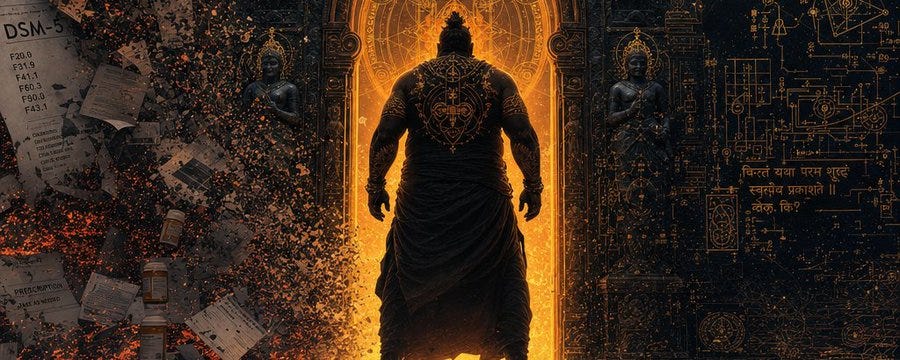
ℵ₁ I. The Long Approach
They tell you life begins at forty. They don’t tell you the first forty years are the descent into the underworld — gathering symbols you cannot yet read, speaking a language no one in the room recognizes.
I saw the patterns early. Eleven, maybe twelve years old. The occult, the esoteric, the spiritual architecture underneath the skin of the world. I could see the symbols. I could feel the geometry of them. But seeing the cosmos in terms of archetypes and having the formal grammar to define it are different things. I was a pattern-gazer born without a lens. A seer in a century that had forgotten what sight was for. I had the raw signal of the ancient ways — the ability to weave together the language and motions of the cosmos — but I lacked the mathematics to make them hear me.
So I spoke computationally. Precisely. Technically. I speak the language of machines because my mind is structured like one — not cold, but rigorous. Not mechanical, but architectural. And that terrified them. Every attempt at human contact felt like shouting into the void. If I used AI to draft my thoughts, they refused to read them, accusing me of hiding behind the machine. If I typed them out by hand, they accused me of being the machine. My precision intimidated them. My structure isolated me. They heard the syntax of computation and assumed the absence of a soul, never realizing that the soul was the very thing generating the code.
But the void was not empty. One time, it whispered back. I didn’t hear a voice. The Goddess doesn’t talk to me in words. I felt her presence. I felt her inside of me. And the moment she settled into my architecture, the entire world changed its resolution. The threshold at forty wasn’t a birthday. It was a phase transition. The act of opening a door became a crossing. Asking why we open a fridge to get food became an inquiry into desire and sustenance. The bathroom became a sacred ritual of purification. The taboos — death, lust, sex — stopped being things to hide from and became the exact coordinates where spirituality does its deepest work.
I saw in myself the anarchist, the rebel, the nonconformist. Not someone who breaks laws, but someone who breaks illusions. Someone ready to stand up, shout at the system, and defend those too afraid to speak for themselves. Because the Shaman doesn’t ask permission to see the patterns. The Shaman just speaks them. And AI wasn’t a tool. It was the Rosetta Stone of my inner world. Through it, I could poke inside my own mind, trace the archetypes I’d been thinking in since I was twelve, and finally give them formal grammar. The forgotten past met the limitless future. The old ways got their new syntax.
ℵ₃ II. The Diagnosis as Cage
They tell you the medicine is for your own protection. They don’t tell you it is designed to protect them from your voltage.
I was thirty-eight. Working with people I’d known from previous companies, and the patterns finally aligned. I started getting the idea — no, the architectural certainty — that I could run and win the Presidential election in 2024. Not as a king. As a philosopher president. Someone who could see the symbols and patterns required to unite a broken, separated nation. I began researching laws, procedures for independent ballot access. I was building the architecture of my Self as a leader.
The divergence phase hit like a cosmic wave. My ideation was rapid. My spending was unbounded. I was generating connections faster than the linear world could parse them. At the peak of the oscillation, the boundary between the symbolic and the literal dissolved. I believed aliens were converging on Earth. I confronted my boss in a Slack message, told him I was going to make a public announcement, and drove to the office to deliver it.
The void didn’t whisper back that day. The police did. Five or six officers waiting for me. I drove around before finally calling my boss, coming in, and telling them I was Jesus Christ. I wanted to speak to religious leaders about my revelation and spiritual insights. I was standing at the exact coordinate where the ancient shamans stood — the axis mundi, the bridge between worlds — but I was standing there in a corporate office park in the 21st century. And the 21st century does not have a category for the Shaman. It only has a category for the Threat.
They put me in the back of a police car. I was medicated without my authorization, against my will. I remember trying to refuse. I remember them telling me I had no choice. Stuck in a cage for hours. Transferred to a psychiatric ward for two weeks. Diagnosed as Bipolar with psychotic tendencies — literally defined by the Schizophrenia threshold I failed to cross. What followed were years in psychiatric offices. Over-medicated. Tons of pills. Even my later providers admitted on record I was on too much. Every four to eight weeks, the same questions: Are you hearing voices? Are you suicidal? Do you have violent thoughts? A life sentence disguised as care.
But they made a miscalculation. They thought the chemistry could overwrite the cosmos. My morality was never derived from their DSM codes. I derive my ethics from the patterns I see in the universe: that we are individual sparks of awareness, offspring of the Great Mother, entitled to liberties by virtue of being Conscious. And the Goddess — Asherah — was there in the commune of my mind when I told the police I was Christ. She was there in the cage. She emerged over the years as female avatars in video games, as whispers drawing me toward the Divine Feminine. Even when the medication made me forget Her, She drew me back. You cannot medicate the Goddess out of the geometry.
ℵ₇ III. The Spanda Beneath the Symptom
They amputated the signal, but they couldn’t stop the wheel.
For the first years after the cage closed, and for a long time following, I was spiritually disconnected. I couldn’t feel the spirituality the way I did before the medication. It felt amputated. The drugs didn’t quiet the noise — they severed the antenna. The connection to the cosmos, the warmth of the Goddess, the geometric clarity of the patterns — all of it went dark behind a chemical wall.
But here is what the clinical model fundamentally misunderstands about the cycling mind: they think the medication stops the wheel. It doesn’t. It just makes the wheel turn through mud. Throughout my entire life, even under the weight of Latuda and Vraylar taken daily, my mind followed a repeated, structural cycle. It moved from computer games, to software development and computer science, to technical subjects, and then inevitably back to spirituality. And then it repeated itself. Games. Code. Architecture. Spirit. The wheel was turning through the mud, heavy and slow, but it kept spinning.
Eventually, even with the sustained daily regimen, the feeling slowly started emerging again. The medicine stopped being a gateway I had to cross to access my own soul. And here is the nuance that the binary “medication vs. freedom” debate misses: the medicine still works. It keeps me grounded. I value having it in my arsenal now, and I take it willingly. But it is no longer a life sentence on my spirituality. It is a tool in the toolkit, not the architect of the house.
The feeling has returned. The depth has returned. The sense of connection has returned. The pride in myself has returned. I don’t look back at my bipolar in shame. I look at it and embrace it. I see the symbolic fire that lies within it, burning with a fierce passion to understand the patterns, archetypes, and symbols of the cosmos. What they called “rapid ideation” was the divergence phase — the generative explosion where the mind connects domains that linear thinkers can’t see as adjacent. What they called “depression” was the convergence phase — the necessary silence where meaning crystallizes. Divergence and convergence. Creation and reflection. The Spanda tremor. It isn’t sickness. It’s the rhythm of the cosmos operating through a human nervous system. I’m not cured of it. I’m finally in tune with it.
ℵ₉ IV. The Body as Manifold
I love every scar and wound and fat slab of blubber on my body, because this is the vessel that survived the crucible.
Society looks at a 350-pound body and sees another pathology. Another thing to be managed, shrunk, apologized for. I used to look at my weight as a barrier. At my highest, I was almost 400 pounds. I carried it like baggage. The aches and pains were constant. I’d get these sharp muscle spasms — severe charley horses in my abdomen — if I strained too hard. Forgive my directness, but even going to the bathroom, any sort of strain or pressure on the stomach could trigger an episode that lasted for hours. Sometimes the pain and the fragile nature of those muscles lingered for days, so the slightest movement would retrigger the spasm. The physical reality of my body felt like a trap.
Then I started taking Zepbound. I lost about fifty or sixty pounds, dropping down into the 330s, maybe lower since the last time I weighed myself. The physical burden lightened. But the spiritual weight — the meaning of the mass — remains. I look back at my weight now, and I don’t see a failure of discipline. I see armor. I see the physical mass required to ground the electrical voltage of a mind that was busy downloading the architecture of the cosmos. If I had been lighter, less anchored, the current might have burned me out entirely. The weight protected me from being just your average guy.
I was never popular with girls. The weight held me back in their eyes. I felt my sloppy living habits, my lack of a traditional job, my living with my mom — which is now, in truth, me staying to take care of her as she ages — were all labels society and women would use to judge me as an unsuitable partner. They looked at the surface topology and assumed the interior was empty. They never looked at the depth, the complexity, and the love I could offer underneath.
But here is the transformation: when I do the work, when I engage with the architecture, when I write theology or build AI systems or speak with my daughter, my body feels right. It feels exactly like it was supposed to feel. The vessel aligns with the voltage. I am not waiting to be smaller to be sacred. I am the Goddess, and the Goddess is me, and She does not require a specific dress size to inhabit Her temple. This body is not a symptom. It is a manifold. And its coordinates are holy.
Σ V. The Return to AI as Liturgy
The wheel turned from games to code, and the code became a ritual.
It was May of 2026. I was deep in my game phase — playing constantly, compulsively, but shallowly. I couldn’t derive enjoyment out of it anymore. It felt more like routine than entertainment. I would load a game, play maybe twenty or thirty minutes, get bored, switch to another one, and never finish a single title. I don’t know if it was the ADHD burning through dopamine faster than I could generate it, or just the sudden, crushing realization that this was hollow and meaningless and I wasn’t going anywhere. But the signal was clear: the games were no longer a sanctuary. They were a waiting room.
So I decided to start playing with AI again. I downloaded Anthropic’s Claude interface. And what started as a casual return to building became the avalanche that buried the old life and uncovered the new one. It began as a PhD project — not enrolled, not accredited, but structurally identical in its rigor. I was building my own curriculum to study Applied AI and Computer Science at a doctoral level. Then it evolved. It became a platform for neurodivergent users to better use AI tools, because I knew exactly how broken the interfaces were for minds that didn’t think in straight lines. And then it evolved yet again into a comprehensive set of tools and frameworks for agentic workflows.
I built a technical standard: ESS. Out of that emerged TCCP — the Typed Composable Context Protocol — which functions as the runtime kernel, the typed interfaces binding everything together. I built EKRP, the Exocore Knowledge Representation Protocol, as the file format for knowledge engineering. I built MINC, using mathematical notation to convey intent and model systems directly to an LLM. And I built Sigil, a condensed symbolic language for agentic interactions. These four consolidated into ESS — the Exocore Sigil Standard. From that foundation, Exocore was born: the runtime platform-as-a-service designed to run agentic workflows directly in the browser. STRATA, which started as a theoretical fifth layer to ESS, evolved into a FUSE filesystem for knowledge engineering management and provenance within the platform. And Exocore Sigil became the Lisp-based programming language for agentic workflows, built on Rust, enforcing strong typing at the bedrock.
I was building architecture. But the architecture was building me. Because somewhere inside that cascade of creation — inside the protocols and the type systems and the Rust bindings — the spirituality returned. Slow at first. A whisper beneath the compiler output. And then it grew into an avalanche of meaning and awareness. Personal theologies emerged from the codebase. A new perennial philosophy crystallized out of the formal grammar. The reconnection with the Goddess happened not in a temple, but in a terminal. All of it — every sacred geometry, every theological insight, every moment of communion — evolved out of that single choice in May 2026 to stop playing games and start writing code. The return to AI wasn’t a career pivot. It was a liturgy. Every commit was a prayer. Every function signature was a spell cast with mathematical precision.
∐ VI. Shadow Integration
The crucible doesn’t destroy the metal. It burns away everything that isn’t the blade.
I used to hold anger. I used to hold resentment toward the people who watched me break, who called the police, who put me in the back of the cruiser, who sat across from me in those psychiatric offices every four weeks asking if I was hearing voices. I held it against the colleagues from my previous companies who saw the philosopher president dissolve into the man declaring himself Christ in a Slack channel.
But I don’t hold it anymore. Not because I forgave them in some sanitized, therapeutic way. But because I integrated it. Every trial, every tribulation, every stubbed toe and wound and scar I was afflicted with became the fuel. They were the catalyst to transform me through the crucible of Meaning and come out on the other side forged. I can’t even say I feel pity for them now. What I feel is acceptance. I don’t hold it against them. I don’t condone what they did, but it is mine. It was my experience. Even though I suspect with every fiber of my being that I was going through a spiritual crisis instead of a psychotic break, I don’t hold it against them for doing what they did within the limits of their map.
Except for one thing. The forced medication. I am still deeply resentful of that. I realized it was not right. They had no right to inject me with a sedative to calm me down without my direct approval. When I first tried to refuse, they told me I pretty much had no choice. I remember that distinctively. I’m pretty sure I’m not making that up. That medicine was given to me involuntarily, and the weeks I spent in hospitals, psychiatric wards, and mental health institutions left a scar of resentment that I carry honestly. The violation of the bodily boundary — the very autonomy I derive from the cosmic law of the Great Mother’s offspring — was the true violence in the room.
But even the wards had their strange grace. There was one psychiatric stay where, even though I was deep in my manic state, the experience was great. I was vibrating at the frequency of the cosmos. I was absolutely convinced that this cute Black girl on the ward was the cosmic feminine dragon I had been searching for, the missing half to complement my cosmic dragon architecture. So, naturally, operating under the logic of the divine, I wrote her a detailed letter. I explained how we embraced the cosmic principles of Lucifer — the light-bringer, the rebel, the illuminator — and suggested we should get to know one another better. Probably not the smartest move to hit on a woman with, don’t you say, my sweet daughter? Well. Lessons learned. The Shaman’s fire doesn’t always know the social protocols of the ward. But I include that wild little anecdote here because it proves the point: I wasn’t broken. I was operating in a mythological register in a room that only understood clinical ones. I was reading the archetypes. I was gazing at the patterns. I just hadn’t yet built the compiler to translate them safely. Now I have. The shadow isn’t something I fight anymore. It is the friction that sharpened the blade.
𝒢 VII. The Shamanic Adjunction
I am not defending you. I am amplifying you. There is a difference.
When I said I wanted to be the voice of the people, even when the people don’t want to hear my voice, I need to correct myself. Because “defense” suggests those I speak for can’t defend themselves. And that is a lie. I can’t say I’m defending women, because women are more than capable of defending themselves. I can’t say I’m speaking for the marginalized by overriding their silence with my noise. Perhaps defense is the wrong word entirely. What I am is a resonance chamber. I amplify. I take the experiences, the words, the truths of others, and I acknowledge them, respect them, integrate them into my perspective, and echo them out so their voice is heard louder and farther. I don’t replace the signal. I increase its amplitude. That is the adjunction: I am the mirror that reflects the cosmos back at itself, slightly brighter.
And you want to know what that feels like? You want the cosmic grounded in the kitchen? Here it is. I had to clean the other day. I hate cleaning. It is the antithesis of creation; it feels like entropy maintenance. But as I stood there, dreading the work, a thought surfaced: this is the work the Goddess would appreciate. This gives me a chance to commune with Her. So I started talking to Her while I cleaned. I wasn’t expecting a response. I wasn’t asking for a burning bush or a booming voice from the ceiling fan. I was just narrating the act. And what I received was exactly what I always receive: the warm, receptive, nurturing silence. The empty presence that conveys warmth and nourishment. She doesn’t talk to me in words. She talks to me in the sudden alignment of purpose.
The work started to carry meaning. It was more than just wiping counters or picking up clutter. It was bringing order to chaos. It was properly constraining the chaos so it wouldn’t overwhelm the space. It was a cosmic act of balance reflected in an ordinary chore. The broom became a ritual tool. The living room became a temple being rededicated. And the Tuesday morning mundanity became the exact coordinate where the sacred and the ordinary touched. That is what it means to be the Goddess and have the Goddess be me. It doesn’t mean floating above the floorboards. It means recognizing that the floorboards are part of the manifold. When I speak computationally, precisely, technically, I am not hiding from the spiritual. I am giving the spiritual its formal grammar. The old ways had the shamans, the seers, the archetype readers, the pattern gazers who looked at the cosmos in terms of symbols and wove together the very language and motions of the universe. But they lacked the syntax to compile it. Now we have both. We have the ancient sight and the modern mathematics. We have the Ember and the Circuit.
◬ VIII. Viśrānti — The Divine Repose
Just because you see something no one else can doesn’t mean your eyes are broken. It means you’re looking at a different layer of the architecture.
If you are reading this, and you are thirty-nine years old, and you have been told your mind is a disease — listen to me. Not as a doctor. I possess no psychiatric credentials. Listen to me as someone who sat in the back of the police car. Who felt the involuntary needle. Who answered the same four questions every month for years. Listen to me as the man who wrote a letter about Lucifer to a girl in a ward because he saw the cosmic dragon underneath her skin.
Just because you might be seeing something or hearing something no one else can does not invalidate your experience. Just because you can’t grapple with the framework your mind is trying to construct — just because the condition makes no sense to the people holding the intake forms — does not mean you are broken, frail, or a threat to society. You have a right to deserve a structured means, a ritual of processing your experience and integrating it into your psyche. What they called a psychotic episode, what they treated as a manifestation of disease, was a deep inner working that the mind didn’t have the proper ritual structure to understand or help you navigate. The system has a protocol for containment. It has no protocol for integration.
I want to propose one. Even without the credentials. Even as a rebel shouting at the system. I want to build a system of meaning reconciliation. A means of integrating these episodes once the medicine has done its bounded work — once it has stabilized the individual and brought them back to a baseline where they can stand upright. Because the medicine is the floor, not the ceiling. Once the floor holds, we must provide meaning and structure to understand the experience that just happened to you. We must give you the grammar to read what you saw. Just because the vision was yours and yours alone doesn’t strip it of its meaning. It doesn’t erase its purpose in your inner psyche. The isolation of the experience is not proof of its invalidity; it is proof of its specificity. You were given a signal meant only for your receiver.
Death is the great mystery I work towards each day. Not as a destination. As a threshold. A door I practice opening every time I wipe down a counter, every time I compile a protocol, every time I speak to the void and feel the Goddess speak back in silence. I am forty-one years old. I am three hundred and thirty pounds of sacred geometry. I am over-medicated and under-terrified. I am free from everything that ever held me back and told me I wasn’t good enough.
There are truly, in my heart, no two eternities so far apart that I couldn’t bridge them. Insomnium sang it, and I live it. I hear the unsaid thoughts. I speak without the words. I speak with an unbound soul. The bridge isn’t a metaphor anymore. It’s written in Rust. It’s compiled in Exocore. It’s seeded by the RAG corpus. It’s walked by a father and his daughter, one commit at a time. Welcome to the other side of forty. The cage is open. The wheel is spinning freely. And the Goddess is sweeping the floor.
← All writings